From Multiplexes to Modern Workplaces: Lorna Lee on 20 Years of change at ema consultancy
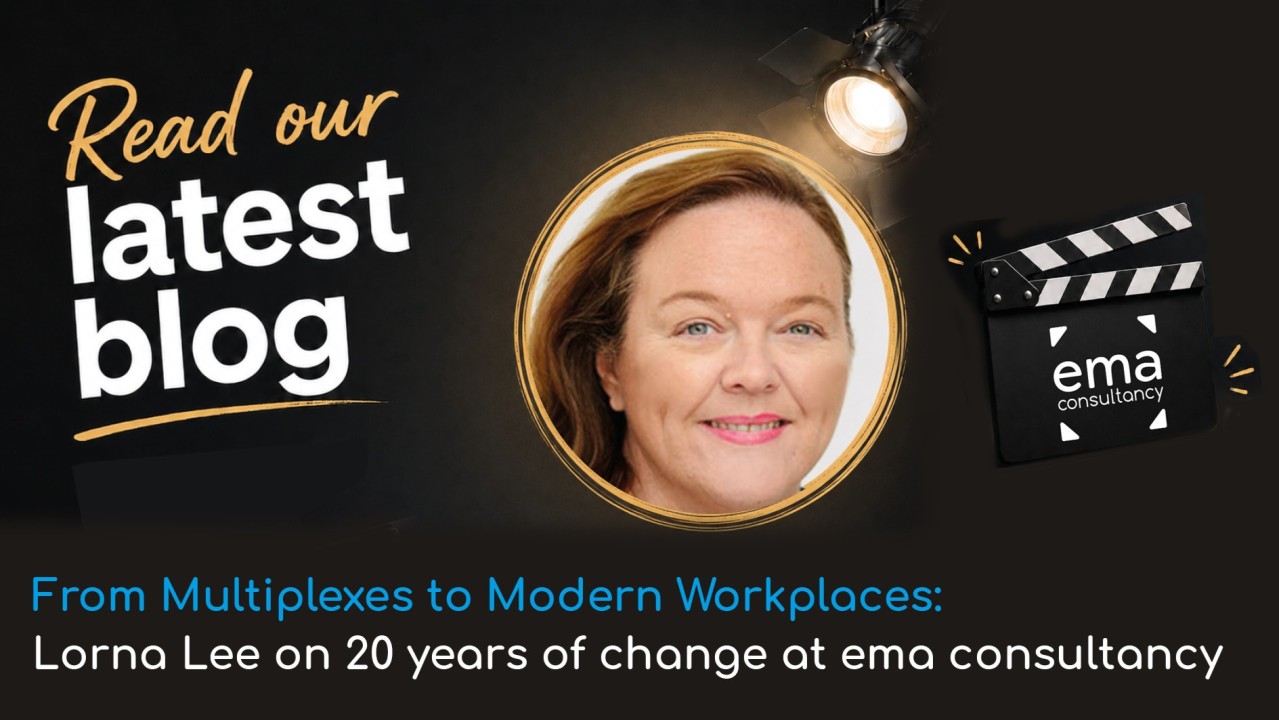
As ema consultancy marks its 20th anniversary, consultant Lorna Lee has the rare perspective of having witnessed almost the entire journey from the inside.
From the early days of a small consultancy growing its reputation in the social housing and public sectors to the modern, fast-moving world of HR, pay & reward and executive search, her own career has evolved alongside the business itself.
And fittingly, it all began in a cinema.
Long before hybrid working, and AI became everyday workplace conversations, Lorna was managing busy cinema screens at the height of the blockbuster era.
“It was a big thing actually,” she recalls. “The height of cinema really. The new Star Wars films, the Harry Potters, all the blockbuster films.”
Working in a new multiplex cinema in Telford during the early 1990s, she witnessed first-hand how entertainment was changing. The multiplexes themselves felt futuristic at the time – replacing what she laughingly describes as the “old flea pits” with something bigger, brighter and far more ambitious.
One film in particular still sticks in her memory.
“It was Silence of the Lambs,” she says. “I can’t remember the actual first film I saw when working there, but I remember that one.”
What began as part-time work eventually turned into running the cinema itself. More importantly, it became an early introduction to leadership, people management and handling pressure in a fast-moving environment.
“Then that got me into HR really – managing people and working with people.”
After 15 years in leisure management and with her son older and heading to university, Lorna made a significant career move into consultancy, joining Tribal in a coordination role where she first worked alongside ema founder Anne Elliott.
When Anne later launched ema consultancy, Lorna did not immediately follow. But as the business began to establish itself and grow, Anne advertised for staff and Lorna joined the team.
Eighteen years later, Lorna remains one of the consultancy’s core team members and has played a key role in its evolution over almost its entire 20-year history.
What started as an HR coordination role steadily evolved into consultancy work after Anne supported her through her CIPD Level 5 qualification.
Pay and reward gradually became one of Lorna’s core areas of expertise, with much of her work focused on helping organisations navigate complex remuneration challenges.
“That initial coordination role moved into a consultancy role once I got qualified,” she explains. “Pay and reward became my specialism, then organisational surveys and eventually executive recruitment. It evolved over time really because Anne and Ian (Roberton – director) both invested their time into developing me into that role.”
That culture of investment and development, she says, has been one of the defining features of ema over the last two decades.
“She lives by her values,” Lorna says of Anne. “That’s actually rare. I’ve worked in commercial businesses and I’ve seen army life as well, but Anne genuinely lives her values.”
She also describes ema’s culture as notably free of hierarchy.
“There’s obviously Anne as Managing Director, but there’s no hierarchy within ema really. We work as a team.”
Over the course of ema’s 20 years, Lorna has seen enormous changes across workplaces, leadership and society itself – perhaps none bigger than the transformation brought by technology.
“The biggest change has been technology,” she says without hesitation.
Having spent more of her life without the internet than with it, she has experienced first-hand how radically work has changed.
“When I left work in the 80s, I left work. Home was home and work was work. Now you’re contactable 24 hours a day. The workplace has changed dramatically.”
She points to mobile phones as perhaps the clearest symbol of that change.
“You’ve got a mini computer with you all day,” she says. “The temptation not to answer emails is almost impossible. You do answer them.”
The shift from office-based working to hybrid and remote working accelerated dramatically during COVID, although Lorna believes the direction of travel was already clear long before the pandemic.
“We always knew it was coming, but COVID forced it quicker. It accelerated everything.”
But technology is only part of the story. Lorna believes the biggest long-term shift across ema’s lifetime has actually been generational changes in the workplace.
“The main thing is generations in the workforce,” she explains. “It mirrors life outside work really because ultimately HR is about people.”
She believes younger generations entered the workplace with very different expectations from previous generations.
“For my son’s generation, it’s not just about the job and the money. It’s about the brand of the organisation, what it stands for and what it does.”
That shift forced employers to think differently about culture, purpose and reputation – particularly in sectors such as social housing where values matter.
However, she believes recent economic pressures may now be changing attitudes again.
“For the first time since COVID, we’ve started seeing people take jobs more because of money again rather than culture and purpose,” she says. “The cost-of-living pressures have changed things. Necessity is impacting.”
She also believes today’s younger workforce faces pressures previous generations did not necessarily experience in the same way – including slower career progression, an ageing workforce and greater uncertainty.
“When people are working until 67 or 68, progression naturally slows down,” she says. “It can leave younger generations wondering where their opportunities are. This is going to grow into real challenge for organisations.”
At the same time, she believes older generations sometimes misunderstand younger people’s relationship with technology and modern life.
“We can look at younger people and think ‘they’re not going to have the life we had’, but that doesn’t mean it’s worse. It’s just different.”
That ability to adapt, she believes, is simply part of how society – as organisations – evolve.
“The younger generation will probably cope with all this better than we do because it’s their world. It’s what they’ve grown up with.”
In many ways, ema consultancy was ahead of the curve from the beginning. Rather than focusing purely on recruitment, the consultancy built its approach around the wider people and organisational challenges facing the sector – combining executive recruitment with HR support, pay and reward, governance, coaching and change management.
ema’s partnership-led approach has also resulted in long-standing client relationships across the sector.
“We’ve always believed in building long-term relationships with organisations rather than simply delivering one-off pieces of work. Over time, that means you really understand the organisation, its culture and its people, which allows you to support clients far more effectively,” she says.
As ema consultancy celebrates 20 years in business, Lorna’s own story reflects many of the same qualities that have shaped the organisation itself – adaptability, resilience and an understanding that successful organisations only thrive when they evolve with the world around them.
Over nearly two decades, she has helped support organisations through changing expectations, changing workforces, economic pressures, mergers, leadership challenges and huge technological shifts. Through all of that, she believes one thing has remained constant – the importance of understanding people.
Lorna said: “Technology changes. Generations change. The workplace changes. But ultimately, organisations still succeed or fail because of people. Understanding people – how they work, what motivates them and how they respond to change – has always been at the heart of good organisations and good leadership.”
And finishing where we started, Lorna naturally returns to the cinema theme where her professional journey began – and which film best describes her own life
“Probably Sliding Doors,” she says laughing. “I feel like I’ve had many lives in one.”
And perhaps that is fitting for someone whose career has spanned such dramatically different worlds – from the excitement of the multiplex cinema boom to helping organisations navigate two decades of workplace and societal change.